Self Guided Tour & Audio Guide

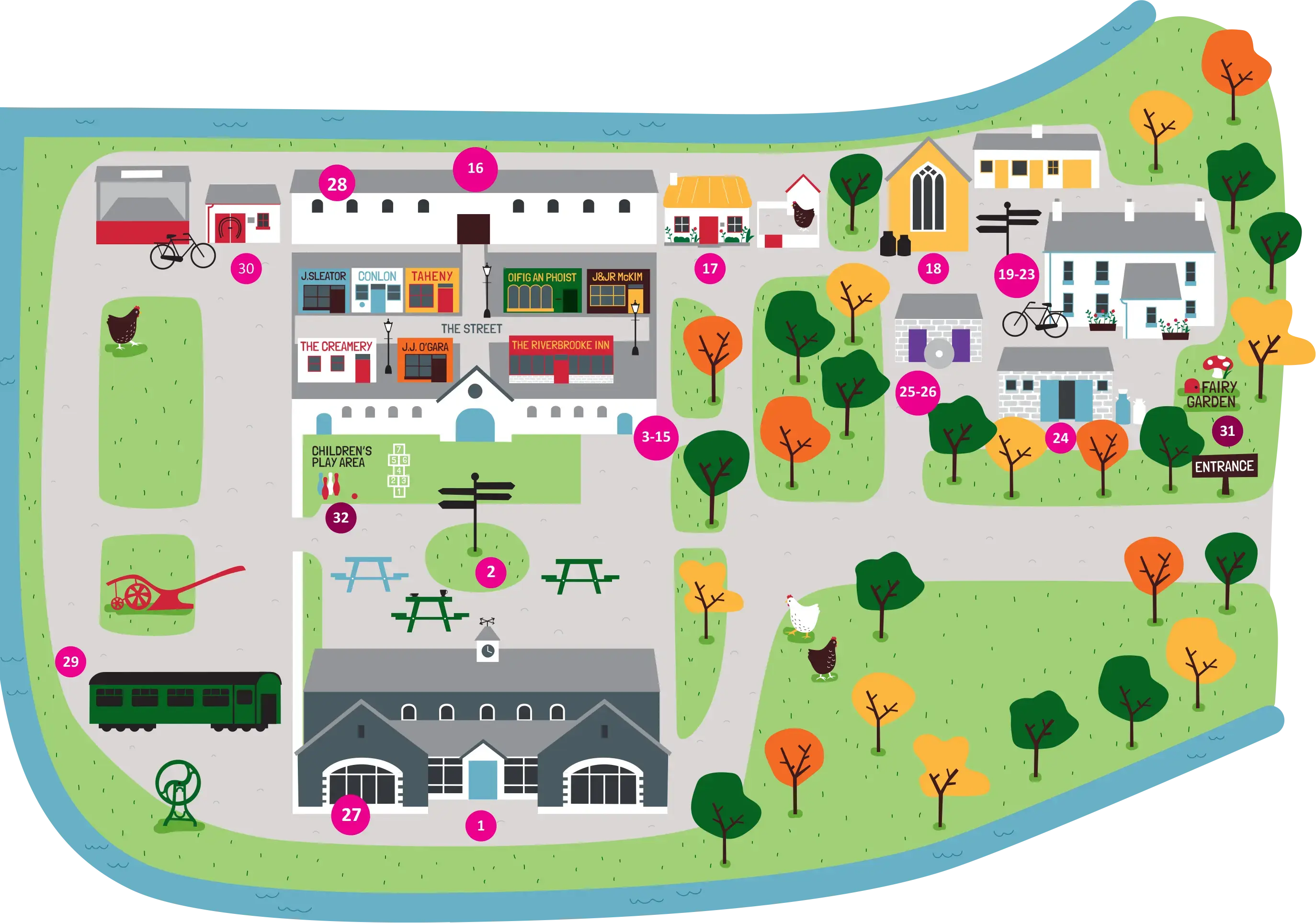
Illustrated site map of Sligo Folk Park showing the Village Street, Millview House and all attractions
01Reception / Shop / Toilets
02The Courtyard / Shop Street
03The Creamery Store
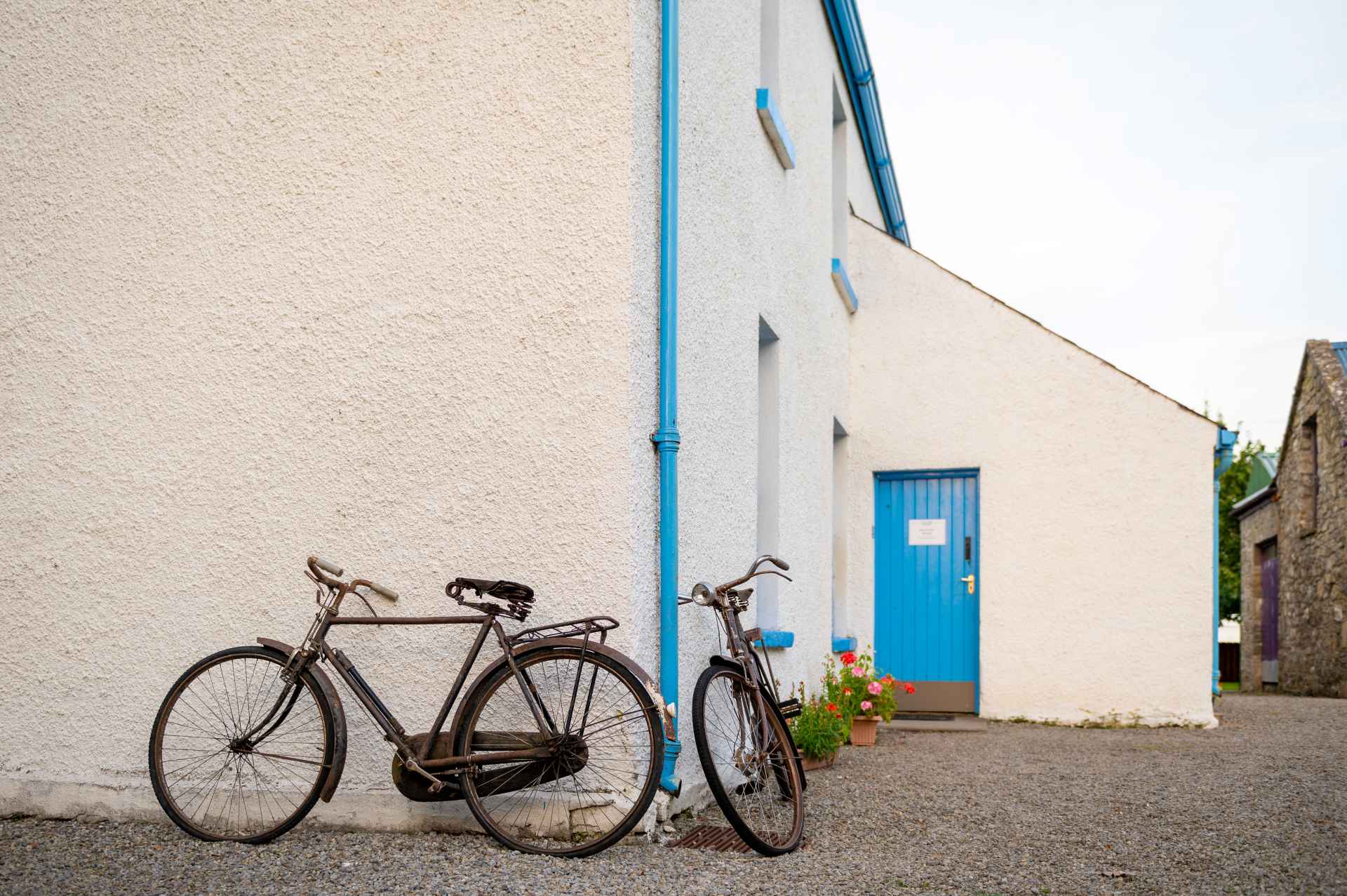
04J O'Gara, Bicycle Shop
05Telephone Kiosk
06Baker's Butchers
07Slattery's Shoe and Boot Shop
08Conlon's & Taheny's
09The Riverbrooke Inn
10Bellow Brothers
11Post Office
12McKims
13Boyd's Chemist
14Sligo Champion
15ESB
16McGee Building / Hands Exhibition
17Mrs Buckley's Thatched Cottage
18The Church / Famine Exhibition
19–23Millview House
24The Dairy House
25Irwin House
26The Schoolroom
27Religious Artefacts
28Military Exhibition
29The Sligo / Leitrim Train Agricultural Machinery
30Kilkenny Forge
31Fairy Garden
32Children's Play Area

Millview House

This fine two storey stone built house dates back to the 18th century and was known locally as Ryan’s House, after the last family to live there. Step inside and you will find a carefully curated collection of furniture and household items from the era, some of which are original to the house itself.

Over the years we have gathered a fascinating tapestry of stories and insights into the families who called Millview House home, and the history of the house itself. Your audio guide will walk you through it all.

The Street

Step off the path and into another era. Our recreated village streetscape is like walking through a small Irish town a hundred years ago, with life size shopfronts lining either side of the street. Some of these shops were real businesses that once operated right here in Riverstown. Others have been brought together from across County Sligo to paint a complete picture of village life before the age of the motor car.

In those days, the village was the centre of everything. It was where you did your shopping, caught up on the news, and met your neighbours. The Street brings that world back to life.

Shopfronts on The Street include Riverstown Creamery, JJ O’Gara Bicycle Store, Baker’s Butchers Shop, Sleator’s Shoe Shop, Conlon’s and Taheny’s Grocery Shops, The Riverbrook Inn, Bellew Brothers, the Post Office, McKim’s Drapery, Boyd’s Chemist, The Sligo Champion and the ESB. Look out too for the old telephone kiosk and the on street petrol pumps, once a familiar sight in every Irish village.
The McGee Building

The McGee Building houses a remarkable and diverse collection of rural artefacts drawn from the McGee Collection, alongside the celebrated Hands Exhibition, named after the RTE television series documenting the traditional craft skills of Ireland.

Filmed around 1980 by David and Sally Shaw-Smith, the Hands series captured these skills at a time when many were still part of everyday rural life. The films play throughout the exhibition alongside the very items featured in them, bringing an extraordinary sense of authenticity to the displays.

The exhibition is divided into three sections. The first covers the typical tasks of rural home life, from basket making and straw weaving to farmhouse butter making and beekeeping. The middle section takes you through the wool trade, from the shearing of sheep right through to the hand weaving of tweed and the tailoring of a fine gentleman’s suit. The final section turns to the land itself, showcasing the water mill and the machines that transformed Irish farming, from ploughing and sowing through to threshing and grinding.

Mrs Buckley’s Thatched Cottage

This charming reproduction thatched cottage is one of the most beloved and storied exhibits in the entire park. Built at Sligo Folk Park in 1994, it is the kind of cottage that would have been a familiar sight around Riverstown in the 1800s. But this particular cottage has had a far more extraordinary life than most.

Celebrated as the World’s Most Travelled Cottage, it made its debut at the Beat on the Peat festival in Yonkers, New York, before going on to appear at festivals the length and breadth of Ireland. It has now settled into its permanent home here at the Folk Park, having welcomed two Presidents of Ireland, Mary Robinson and Mary McAleese, as well as Jean Kennedy Smith of the Kennedy family, during her time as American Ambassador to Ireland.

The Dairy House

The arrival of the creamery changed everything for rural Ireland. It transformed farm businesses, strengthened communities, and brought a new kind of economic life to villages like Riverstown. The first creamery here opened its doors in 1897, and in its heyday the Riverstown Co-op had seven branches and over 1,500 suppliers.

The Dairy House brings this important story to life through a rich collection of displays, including wooden churns, ceramic crocks, and a wide range of items connected to the production of milk and butter in rural Ireland.

Irwin House

Irwin House is home to three very different but equally compelling displays. The first room tells the story of the Irwin family from Riverstown, set against the wider story of emigration and the search for new frontiers. The second room is dedicated to the works of local poet Patrick Higgins, a tribute to the literary tradition of the area.

Step into the back room and you will find yourself transported to a typical 1950s schoolroom, complete with old wooden desks, a blackboard on an easel, and the slates that every child once wrote on. The canes and sticks used for punishment are also on display, a sobering reminder of a very different era in Irish education. Outside the door, look out for the old millstone once used for grinding corn.

Kilkenny Forge

Before the motor car, the forge was the heartbeat of every rural community. Our blacksmith’s forge is an accurate recreation of the one built in Riverstown in 1940 by local blacksmith James Kilkenny, and it has been brought back to life in faithful detail.

All the tools of the trade are here, from the heavy anvil and the massive bellows to the hammers and tongs of a working forge. James Kilkenny was a skilled and versatile craftsman, making and repairing farm tools, crafting decorative ironwork like gates and pot crooks, and becoming especially well known for his turf spades, or loys, which were essential tools in every Irish household.

Emily Barlow

Not all the stories in Sligo Folk Park are about everyday life. Some are about loss, courage, and the tragic events that shaped communities forever.

Emily Barlow was the daughter of John and Margaret Barlow from Riverstown. On the 10th of October 1918, she drowned when the RMS Leinster was torpedoed by a German submarine just four nautical miles east of the Kish Lighthouse, outside Dublin Bay. It was Ireland’s greatest maritime disaster, claiming the lives of over 500 people.

Emily is buried in Deansgrange Cemetery in Dun Laoghaire. Her story is remembered here as a tribute to a young woman from Riverstown, and to all those lost that day.

Military Exhibition

Historian Simone Hickey officially opened our Great War Wall of Honour where more than 600 Sligo-born military personnel and 7 Sligo civilians who died in the conflict have been commemorated. This is part of our Military Exhibition which features artifacts from both the Great War and the Civil war, including Constance Markievicz’ uniform among many other wonderful, authentic items.

Restoration at Sligo Folk Park

Every item you see at Sligo Folk Park has a story, and for many of those items, part of that story is the journey from disrepair back to its former glory. Our dedicated team of staff and volunteers work tirelessly to restore donated artefacts, ensuring that these pieces of Irish heritage are preserved and celebrated for generations to come. We are deeply grateful to everyone who has donated items to our collection and supported our restoration work over the years.

McDonnell
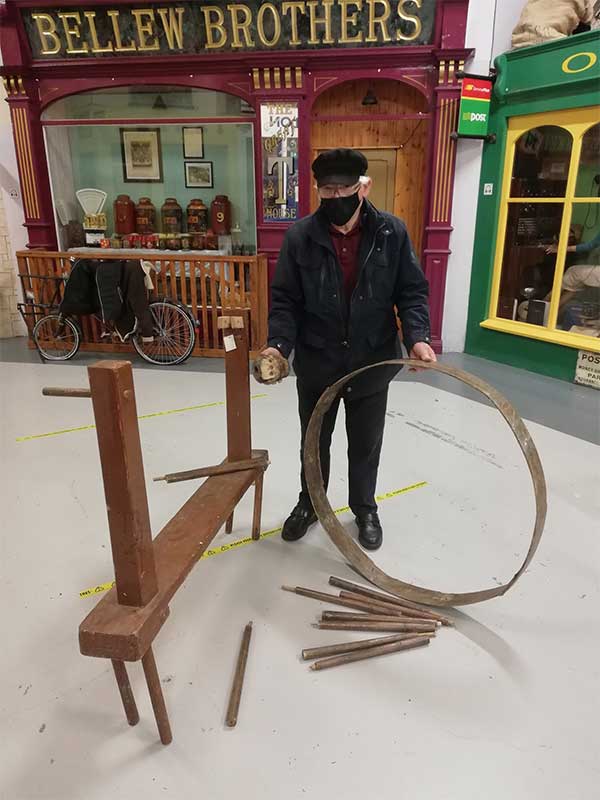
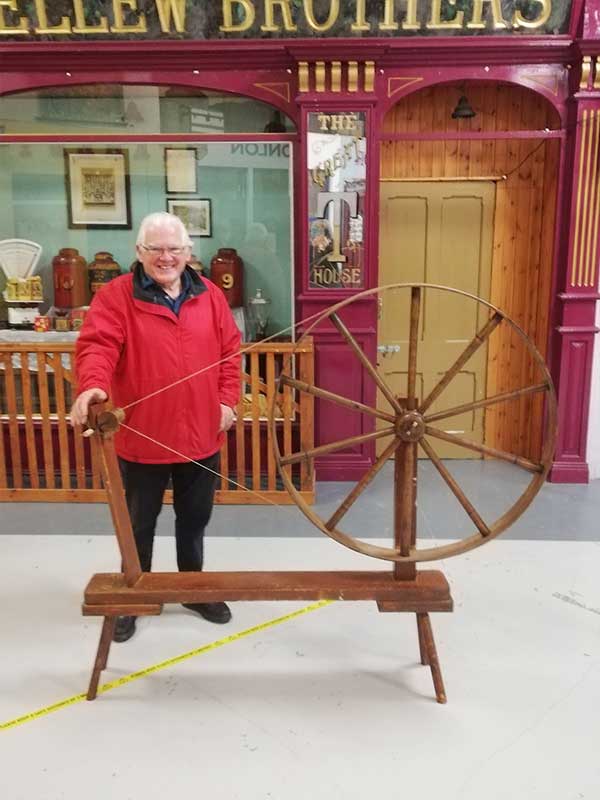
Spinning Wheel

This beautiful spinning wheel was purchased in Dunmore in 1871 by Edward McDonnell of Currisloustia, Ballinlough, County Roscommon, as a gift for his wife Margaret. It was passed down through the family and remained in regular use until as late as 1935, when Margaret’s daughter in law Honoria was still spinning wool on it. Their son William and his wife Annie kindly placed it on loan to Riverstown Museum in 1994.

Typical of the spinning wheels used in West Roscommon and North Galway during that period, it would originally have been worked with the help of neighbouring women, who came together to card and spin the wool. The finished yarn was then knitted into socks, cardigans, and jumpers for the family, a wonderful reflection of the self sufficient way of life at the time.

Our master craftsman Danny has done a magnificent job transforming this 19th century spinning wheel into a fully functional piece once more. It is a joy to see it looking so well.

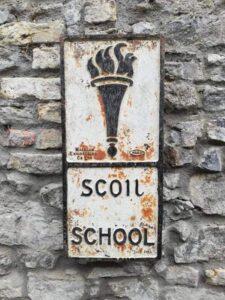
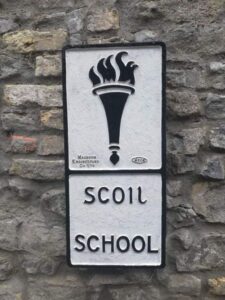
Weathered cast-iron Scoil / School sign on a stone wall, part of the Hands Exhibition at Sligo Folk Park Restored cast-iron Scoil / School sign displayed in the Hands Exhibition at Sligo Folk Park

Old School Sign

When the Old School House was being relocated to its new home in Irwin House, it was decided that the original school sign deserved a new lease of life too. Team member Brendan carefully and painstakingly restored the sign back to pristine condition, preserving every detail of the original materials in the process. A wonderful piece of work and a fitting companion to the schoolroom exhibit.

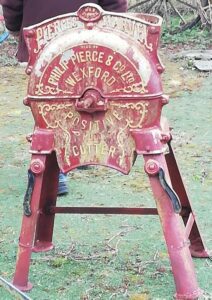
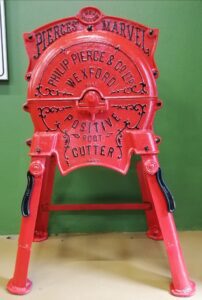
Philip Pierce & Co. turnip cutter before restoration, part of the Sligo Folk Park artefact collection Philip Pierce & Co. turnip cutter fully restored and painted red on display at Sligo Folk Park

Turnip Mangle

A familiar sight in Irish homes and farms until relatively recently, the turnip mangle was used to pulp vegetables for both household and agricultural use. More than a few teenagers will remember the very particular misery of operating one on a cold winter’s morning. We have several at the Folk Park, and this one, manufactured by Pierce Machinery, has been lovingly restored by Eadaoin, a valued member of our team.

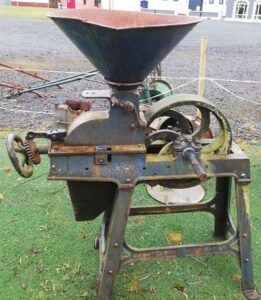
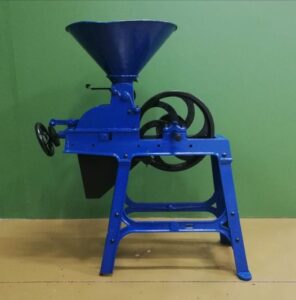
Rusty milling machine before restoration by Sligo Folk Park volunteers, Co. Sligo Milling machine fully restored and painted bright blue on display at Sligo Folk Park, Riverstown

Milling Machine

This milling machine was once used to turn oats and other crops into fine grain, playing an essential role in the rural economy. It has been given a new lease of life by Bernard and Eadaoin from the Folk Park team and looks as good as the day it was made.

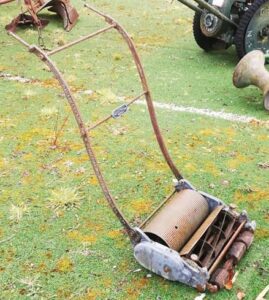
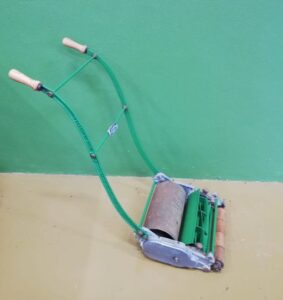
Rusty vintage push lawn mower in the grass before restoration at Sligo Folk Park Vintage push lawn mower restored and painted green, part of the heritage collection at Sligo Folk Park

Ransomes Lawn Mower

Before the age of the petrol engine, keeping the lawn trimmed was a very different kind of effort. Ransomes lawn mowers were a fixture in homes across Ireland during the first half of the 20th century and are now very much sought after collectors items. This one was restored by Danny, who tackled the wooden components, and Fiona, who handled the metalwork. Between them they have produced something truly special.

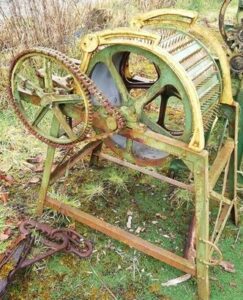
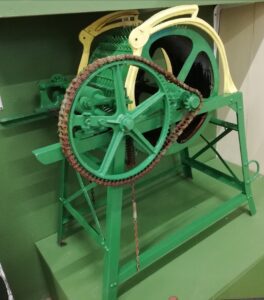
Rusted heritage farm machine with large gear wheels awaiting restoration at Sligo Folk Park Restored horse hair carder machine on display in the Hands Exhibition at Sligo Folk Park, Co. Sligo

Horsehair Carder

One of the most talked about items in the McGee Collection, the horsehair carder was a highly specialised piece of equipment used to separate the thick hair from a horse’s mane and tail into finer strands suitable for weaving or knitting. Unlike the smaller wool carders you may have come across, this was a substantial and very particular tool. Restored by Eadaoin, you will find it in the wool and weaving section of the Hands Exhibition in the McGee Building.

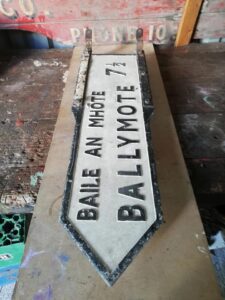
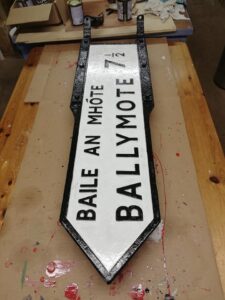
Ballymote / Baile an Mhóte bilingual road sign before restoration at Sligo Folk Park Ballymote / Baile an Mhóte bilingual road sign after restoration at Sligo Folk Park, Riverstown

Original Street Signs

Once a familiar sight on roadsides and street corners all across Ireland, original cast iron street signs have become increasingly rare, with many in a state of serious disrepair. Our team at Sligo Folk Park have lovingly restored a number of these signs, and they are now proudly on display along our Village Street. It is a real pleasure to see them back where they belong, surrounded by the artefacts and stories they were always part of.

Plan Your Visit

Whether you are popping in for a few hours or making a full day of it, Sligo Folk Park has plenty to see, explore, and enjoy. Here is everything you need to know before you arrive.

Opening Times

Monday to Friday (All Year)
10am to 5pm, last tour at 4pm
May to September (Saturday)
10am to 5pm
May to September (Sunday and Bank Holidays)
12 noon to 5pm

Admission Prices

Adult: €12
Child (4 to 16 years): €6
Family (2 Adults and 2 Children): €30
Discounted Adult: €10
Children under 4: Free
Group rates available (over 10 persons)

Location

Sligo Folk Park is located in the heart of Riverstown village, just 15 minutes from Sligo Town and Boyle, Co. Roscommon.
Eircode: F52 TX06

Get Directions

Events

From our Easter Eggtravaganza to the famous Halloween Scare in the Park, we host a packed calendar of seasonal events the whole family will love.

Find Out More

What Our
Visitors Say

Never Miss
a Moment

Be the first to hear about upcoming events, seasonal openings, and news from Sligo Folk Park. Sign up to our newsletter and never miss a thing.

Instagram